
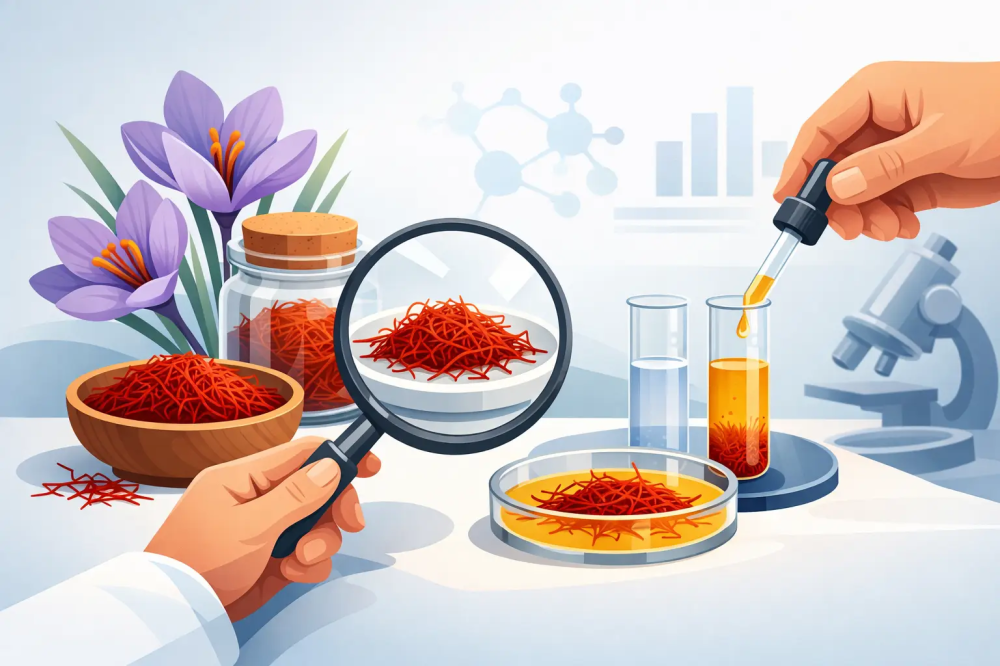
Many methods for testing saffron at home are widely shared: placing threads in water, rubbing them, smelling the aroma, or observing how quickly they release color. However, no single home test can conclusively prove saffron purity or authenticity.
Home observations may reveal obvious irregularities, but they are different from standardized laboratory testing, which can assess saffron characteristics and detect foreign materials more objectively.
What Does Saffron Purity Mean?
Natural saffron comes from the parts of the Crocus sativus L. flower that are harvested and dried for use as saffron.
When discussing purity, the question is not simply how red the threads look or how strongly they color water. It also concerns whether the product contains foreign plant material, undeclared additives, or other substances.
It is useful to distinguish between three concepts:
Authenticity: Is the product actually saffron?
Purity: Does it contain foreign or undeclared material?
Quality: What are the characteristics of the saffron itself?
These concepts are related, but they are not identical.
Does the Saffron Water Test Prove Authenticity?
The water test is one of the most commonly suggested home tests for saffron.
When saffron is soaked in water, soluble compounds begin moving into the liquid and its color gradually changes. However, the speed of color release alone cannot conclusively establish authenticity or purity.
The result can be influenced by factors including the amount of saffron, water temperature, drying method, storage conditions, and the physical condition of the threads.
Water can therefore be useful for observation, but fixed rules such as “if the water changes color within a certain number of seconds, the saffron is fake” should not be treated as reliable proof.
Do Threads Staying Red After Soaking Prove Authenticity?
No.
The appearance of saffron threads after soaking can provide another observation, but it does not independently prove that the product is authentic or pure.
Likewise, a change in thread color does not automatically indicate adulteration. Saffron is a natural plant material, and its characteristics change during soaking and use.
A single visual observation should therefore not be used as a definitive authenticity test.
Can You Test Saffron by Rubbing the Threads?
Rubbing saffron threads between your fingers or against a damp surface may sometimes reveal obvious external coloring, but this is not a standardized purity test.
The absence of obvious artificial color does not prove that a sample contains no foreign material. Similarly, some natural color transfer from saffron does not mean the threads have been artificially dyed.
This method should be treated only as an initial observation.
Can Aroma Identify Authentic Saffron?
Saffron has a distinctive aroma associated in part with safranal, one of its characteristic compounds.
However, evaluating aroma by smell is subjective. Aroma intensity can also be affected by the age of the product, drying process, packaging, and storage conditions.
Aroma is therefore useful in sensory assessment, but it cannot independently prove authenticity or purity.
Can Thread Appearance Reveal Adulterated Saffron?
Examining saffron threads may help identify obvious foreign materials that do not resemble parts of the saffron flower. Buying saffron as threads rather than powder can therefore make visual inspection easier.
However, adulteration or the addition of other plant materials may not always be obvious to the naked eye.
Thread appearance can raise suspicion or support an initial assessment, but it does not replace specialized testing.
For other warning signs worth checking before purchase, read: 7 Signs That May Indicate Adulterated Saffron
What Is ISO 3632?
ISO 3632 provides an international framework for specifications and testing methods for dried saffron from Crocus sativus L.
It applies to saffron sold as whole threads, cut threads, and powder.
Standardized testing provides a more objective basis for evaluating saffron characteristics than home observations alone.
Important compounds associated with saffron's principal characteristics include:
- Crocin: associated with coloring strength.
- Picrocrocin: associated with taste.
- Safranal: associated with aroma.
Saffron testing can also address factors such as moisture and foreign matter that cannot be accurately determined simply by placing a few threads in water.
Does ISO 3632 Prove the Country of Origin?
No. Quality testing and geographical origin are separate questions.
A saffron sample meeting particular specifications does not automatically prove that it originated in Spain, Iran, or any other country.
If origin matters, check the declared country of origin, product information, traceability, and origin certification when applicable.
For example, Spanish La Mancha PDO Saffron is associated with a Protected Designation of Origin system linked to a defined geographical area and traceability requirements, while Iranian Saffron refers to saffron originating in Iran.
For a broader comparison of these two origins and their documentation systems, read: Spanish vs Iranian Saffron: What Is the Difference and Which Is Better?
When Is Laboratory Saffron Testing Necessary?
For ordinary household purchases, checking origin, packaging, supplier information, and available product specifications provides a practical basis for making a decision.
If you need technical verification of purity or specifications for commercial, regulatory, or investigative purposes, testing by a qualified laboratory provides stronger evidence than home methods.
Laboratory analysis can assess characteristics that cannot be measured accurately through sight, smell, or water testing alone.
How Should You Check Saffron Before Buying?
Instead of relying on a single test:
- Check the country of origin.
- Review the product and packer information.
- Choose intact packaging with clear labeling.
- Review traceability or analytical information when available.
- Visually inspect threads for obvious foreign material.
- Do not treat color, aroma, or price as independent proof of authenticity.
- Use laboratory analysis when technical verification is required.
For a broader purchasing checklist, read: Authentic Saffron Buying Guide: What to Check Before You Buy
Does Verification Differ Between Spanish and Iranian Saffron?
The basic principles of saffron assessment are similar, but the way origin and classification are verified differs.
When buying Spanish saffron, check the country of origin. For La Mancha PDO, you can also look for the Protected Designation of Origin system and its associated traceability. For more detail, read: How to Identify Authentic Spanish Saffron
For Iranian saffron, commercial classifications such as Negin, Super Negin, Sargol, and Pushal describe thread selection and appearance, but do not independently prove quality. For more detail, read: How to Identify Authentic Iranian Saffron and Its Quality
Testing Antonio Sotos Saffron
Antonio Sotos has specialized in saffron since 1912 and offers Spanish La Mancha PDO Saffron and Iranian Saffron in Saudi Arabia.
Regardless of brand, the same principle applies when assessing saffron: verifiable product information and standardized testing provide stronger evidence than claims or isolated home tests.
Can You Really Test Saffron Purity at Home?
At home, you can inspect saffron and observe certain unusual characteristics, but a single water, color, aroma, or rubbing test cannot conclusively establish purity or authenticity.
For a more objective assessment, look for clear information about origin, product specifications, and traceability. When technical verification of purity or quality is required, laboratory testing using recognized methods provides stronger evidence.