
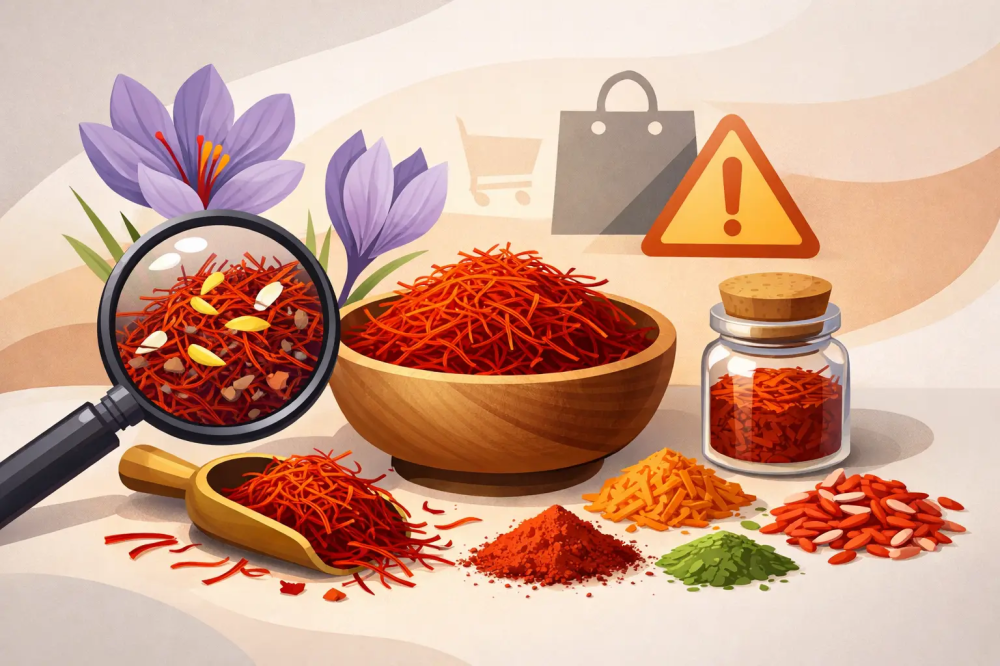
Saffron adulteration can take different forms, including the addition of other plant materials, artificial coloring, unwanted plant parts, or misleading information about a product's identity or origin.
However, it is important to distinguish between a warning sign and proof of adulteration. Color, aroma, appearance, or a single home test usually cannot conclusively establish that saffron is adulterated.
Here are seven signs worth checking before buying saffron.
1. The Country of Origin Is Unclear
One of the first things to check on a saffron package or product page is the country of origin.
Statements such as “Packed in Spain” or the presence of a Spanish company name do not necessarily mean that the saffron itself originated in Spain.
Iranian saffron, for example, may legitimately be selected or packaged in Spain.
The issue is not that the country of origin and country of packaging are different. The warning sign is when origin information is missing or presented in a way that may create confusion.
2. Important Product Information Is Missing
A clearly labeled product should provide basic information that helps buyers understand what they are purchasing.
Look for information such as:
- Product name.
- Net weight.
- Country of origin.
- Company responsible for the product or packaging.
- Expiry or batch information when applicable.
- Relevant storage or regulatory information.
Missing information does not automatically prove adulteration, but it reduces your ability to verify the product.
3. Obvious Foreign Material Is Present
Buying saffron as threads makes visual inspection easier than buying it as powder.
If you notice clearly foreign plant material or pieces that differ substantially in structure from the rest of the product, further investigation may be justified.
Visual inspection has limits, however. Some foreign materials or forms of adulteration may not be obvious to consumers without specialized analysis.
Appearance can reveal certain problems, but it cannot establish complete purity.
4. Unusual Surface Coloring or Obvious Dye
Saffron naturally contains compounds responsible for its coloring properties, particularly those associated with crocin.
However, obvious signs of unusual surface coloring or external dye may justify closer examination of the product.
At the same time, be cautious with the common claim that rapid color release automatically means saffron is fake.
The speed at which color moves into water can be affected by several factors, so timing alone cannot conclusively establish authenticity.
5. Powdered Saffron With Insufficient Information
Saffron can legitimately be sold as powder, and ISO 3632 also covers powdered saffron.
However, powder is more difficult for consumers to inspect visually than whole threads because the original plant structure is no longer easily visible.
When buying powdered saffron, supplier identity, product information, specifications, and analytical data when available therefore become particularly important.
Powder itself is not evidence of adulteration; it simply limits visual inspection.
6. Strong Quality Claims Without Verifiable Information
Claims such as:
“The world's best saffron”
“Highest quality”
“Grade A”
“Super Negin”
do not independently prove quality.
Some terms are commercial descriptions, while others may describe thread selection or appearance rather than laboratory results.
When assessing quality claims, look for information that can actually be verified: origin, classification, specifications, traceability, or analytical results when available.
7. A Price That Does Not Match the Product Information
Price alone cannot prove whether saffron is authentic or adulterated.
Saffron prices vary according to origin, harvest, grade, quality, packaging, quantity, and supply chain.
An exceptionally low price compared with similar products may be a reasonable reason to verify the weight, origin, labeling, and supplier more carefully before buying.
The reverse is also true: a high price does not independently guarantee quality.
For a more accurate approach to comparing saffron prices, read: Spanish vs Iranian Saffron Price: How Should You Compare?
Do Yellow Parts Mean Saffron Is Adulterated?
No.
Yellow or lighter portions of a saffron thread do not automatically indicate adulteration.
Different parts of the saffron flower vary in color, and thread separation and sorting differ according to origin and commercial classification.
In Iranian saffron, for example, terms such as Negin, Sargol, and Pushal help describe thread selection and the portions retained in the product.
A naturally lighter part of a thread should therefore not be confused with foreign material added to saffron.
To understand what classifications such as Negin, Super Negin, Sargol, and Pushal actually describe, read: How to Identify Authentic Iranian Saffron and Its Quality
Can the Water Test Detect Fake Saffron?
A water test can help you observe how saffron behaves, but it cannot independently prove adulteration.
Water temperature, saffron quantity, drying, storage, and thread condition can all influence the result.
There is therefore no reliable scientific rule stating that authentic saffron must take a specific number of minutes to release its color.
For a detailed explanation of home testing, read: How to Test Saffron Purity: Are Home Tests Reliable?
How Can Saffron Be Tested More Accurately?
ISO 3632 provides an international framework for specifications and testing methods for dried saffron.
Important compounds associated with saffron's principal characteristics include:
- Crocin: associated with coloring strength.
- Picrocrocin: associated with taste.
- Safranal: associated with aroma.
Specialized analysis can also assess characteristics that consumers cannot accurately determine through appearance or water testing alone.
When technical verification of a sample's purity or specifications is required, testing by a qualified laboratory provides stronger evidence than home methods.
How Can You Reduce the Risk of Buying Adulterated Saffron?
Instead of searching for one “magic test,” combine several pieces of information before buying.
Check the country of origin, product labeling, supplier, packaging integrity, classification, and available specifications.
When buying Spanish La Mancha PDO Saffron, check its Protected Designation of Origin identification and relevant traceability information.
When buying Iranian Saffron, verify its origin and understand what the stated commercial grade means rather than relying on the grade name alone.
For the complete purchasing checklist, read: Authentic Saffron Buying Guide: What to Check Before You Buy
Does Verification Differ Between Spanish and Iranian Saffron?
Yes, particularly when it comes to origin documentation and classification.
When buying Spanish saffron, first verify that its country of origin is Spain. If the product is sold as La Mancha PDO, you can also check the Protected Designation of Origin system and its associated traceability. For more detail, read: How to Identify Authentic Spanish Saffron
Iranian saffron, on the other hand, commonly uses classifications such as Negin, Super Negin, Sargol, and Pushal, which primarily describe thread selection and appearance rather than independently proving quality.
For a direct comparison of both origins, read: Spanish vs Iranian Saffron: What Is the Difference and Which Is Better?
Antonio Sotos Saffron
Antonio Sotos has specialized in saffron since 1912.
In Saudi Arabia, Antonio Sotos offers Spanish La Mancha PDO Saffron originating in Spain alongside Iranian Saffron originating in Iran and selected and packaged by Antonio Sotos in Spain.
The origin of each saffron is identified separately from the country of packaging so buyers can understand where the saffron itself comes from.
Conclusion
There is no single visual sign that conclusively proves saffron is adulterated.
However, unclear origin, missing product information, foreign materials, suspicious external coloring, unsupported claims, and unusual pricing are all reasonable reasons to investigate further.
The key is to treat these as warning signs rather than definitive judgments. When technical verification of purity or quality is required, specialized testing provides stronger evidence than home tests.