
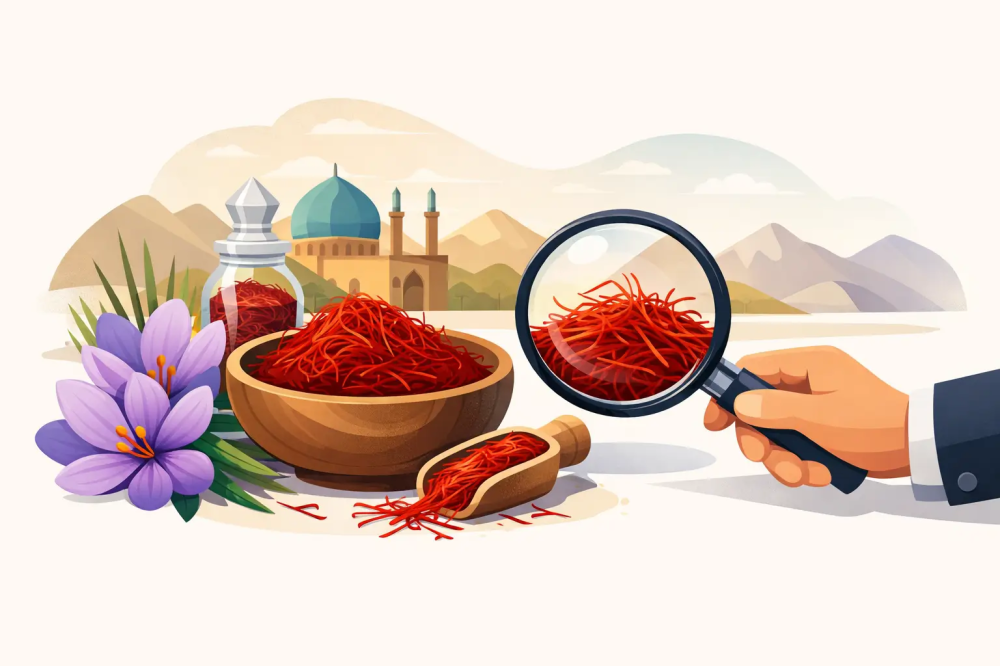
Iranian saffron is one of the best-known origins of saffron worldwide, but its quality cannot be determined by redness or thread length alone. When choosing Iranian saffron, consider origin, purity, sensory characteristics, and quality assessment rather than relying only on appearance.
Saffron comes from the flower of Crocus sativus L. The stigmas are harvested and dried to produce the saffron used in food and beverages.
For the main factors to check before purchasing saffron, read: Authentic Saffron Buying Guide: What to Check Before You Buy
What Is Iranian Saffron?
Iranian saffron is saffron whose country of origin is Iran. The term refers to where the saffron itself was produced, not where it was later processed or packaged.
Iran is one of the world's major saffron-producing countries, and Iranian saffron is widely used in rice dishes, desserts, beverages, and other culinary applications.
When buying Iranian saffron, check the declared country of origin, product information, and the company responsible for packaging.
How Is Iranian Saffron Quality Measured?
There is no reliable rule that “the reddest saffron is always the best.”
The ISO 3632 standard provides an international framework for specifications and testing methods for dried saffron, whether sold as whole threads, cut threads, or powder.
Important compounds associated with saffron's characteristics include:
- Crocin: associated with coloring strength.
- Picrocrocin: associated with saffron's characteristic taste.
- Safranal: associated with aroma.
Laboratory assessment therefore provides more objective information about saffron quality than appearance alone.
For more detail on the limits of water, color, and aroma tests, read: How to Test Saffron Purity: Are Home Tests Reliable?
What Are the Main Iranian Saffron Grades?
Several commercial terms are commonly used to describe the appearance and selection of Iranian saffron threads. Some of the best-known include:
Super Negin Saffron
Super Negin is a commercial term generally used for highly selected saffron threads with a high proportion of red stigma and a relatively long, uniform appearance.
Negin Saffron
Negin is another widely used commercial grade, typically describing selected saffron with prominent red stigma portions and a relatively uniform appearance.
Sargol Saffron
Sargol consists primarily of the red portions of the saffron stigmas after other sections of the thread have been separated.
Pushal Saffron
Pushal saffron may retain lighter portions of the thread in addition to the red stigma.
These terms are useful for describing thread appearance and sorting, but they do not independently establish coloring strength, aroma, taste, or overall chemical quality.
For this reason, a label such as Negin or Super Negin should not be treated as a substitute for product specifications or laboratory analysis.
Is Super Negin the Best Iranian Saffron?
Not necessarily.
Super Negin is generally associated with a particular visual selection and presentation of the threads. That may be desirable for certain buyers, but appearance and grade name alone do not provide a complete measurement of saffron quality.
Purity, moisture, coloring strength, aroma, taste, processing, and storage can also affect the characteristics of the final product.
Therefore, Super Negin should be understood as a commercial grade rather than a universal scientific definition of “the best saffron.”
Is Redder Saffron Always Better?
No.
The color of the threads can provide a visual clue, but saffron quality cannot be reduced to redness alone.
Two samples can appear similar while differing in purity, moisture, coloring strength, aroma, taste, processing, or storage conditions.
A visual inspection is therefore useful, but it should not replace product information or objective testing.
Do Yellow Parts Mean Iranian Saffron Is Low Quality?
The presence of yellow or lighter portions can affect the visual and commercial classification of some Iranian saffron grades, but it does not provide a complete assessment of quality on its own.
It is more accurate to distinguish between:
Thread grade and appearance, and
chemical and sensory quality.
Appearance is one indicator among several, not a definitive test of saffron authenticity or overall quality.
Lighter portions also do not automatically indicate adulteration. For warning signs that may justify closer investigation, read: 7 Signs That May Indicate Adulterated Saffron
How Can You Tell if Iranian Saffron Is Authentic?
There is no single home test that can conclusively prove saffron authenticity.
When buying Iranian saffron, check:
- Country of origin.
- Product and packer information.
- Package integrity.
- Traceability information, when available.
- Whether foreign materials or undeclared additives are present.
- Laboratory specifications or test results, when available.
Popular home tests involving water or color release may provide initial observations, but they are not equivalent to laboratory analysis and cannot conclusively establish authenticity on their own.
Iranian Saffron vs. Spanish Saffron
The fundamental difference begins with origin and classification systems.
Iranian Saffron originates in Iran, where commercial terms such as Negin, Sargol, and Pushal are commonly used to describe thread selection and appearance.
Spanish La Mancha PDO Saffron originates in the La Mancha region of Spain and is governed by a Protected Designation of Origin system covering geographical origin, product requirements, packaging, and traceability.
It is therefore misleading to describe one origin as universally “better” than the other. Their origin, classification, documentation, and product characteristics differ.
For a detailed comparison, read: Spanish vs Iranian Saffron: What Is the Difference and Which Is Better?
Is Iranian Saffron Suitable for Saudi Coffee?
Yes. Iranian saffron can be used in Saudi coffee, as can Spanish saffron.
A grade name such as Negin or Super Negin does not by itself determine how suitable a saffron is for coffee. The result also depends on the characteristics of the individual product, quantity, infusion method, and when it is added.
For a practical comparison of both origins, read: Best Saffron for Saudi Coffee: Spanish or Iranian?
Is Iranian Saffron Cheaper Than Spanish Saffron?
Not necessarily in every case.
Prices vary according to origin, classification, specifications, quality, package size, packaging, and supply chain. Country of origin alone therefore does not determine whether a saffron product is expensive or inexpensive.
A more accurate comparison looks at the price per gram of specific products together with their specifications.
For more detail, read: Spanish vs Iranian Saffron Price: How Should You Compare?
Antonio Sotos Iranian Saffron
Antonio Sotos has specialized in saffron since 1912.
In Saudi Arabia, Antonio Sotos offers Iranian Saffron originating in Iran, selected and packaged by Antonio Sotos in Spain, alongside Spanish La Mancha PDO Saffron.
This distinction keeps the country of saffron origin separate from the country of packaging.
How to Choose Good Iranian Saffron
Do not base your decision solely on the terms Negin or Super Negin, or on how red the threads appear.
Start by checking origin, product information, purity, packaging, and traceability. Treat the commercial grade as additional information about thread selection and appearance rather than a definitive laboratory assessment of quality.
When analytical data based on recognized standards such as ISO 3632 is available, it provides a more objective basis for evaluating saffron characteristics than appearance alone.