
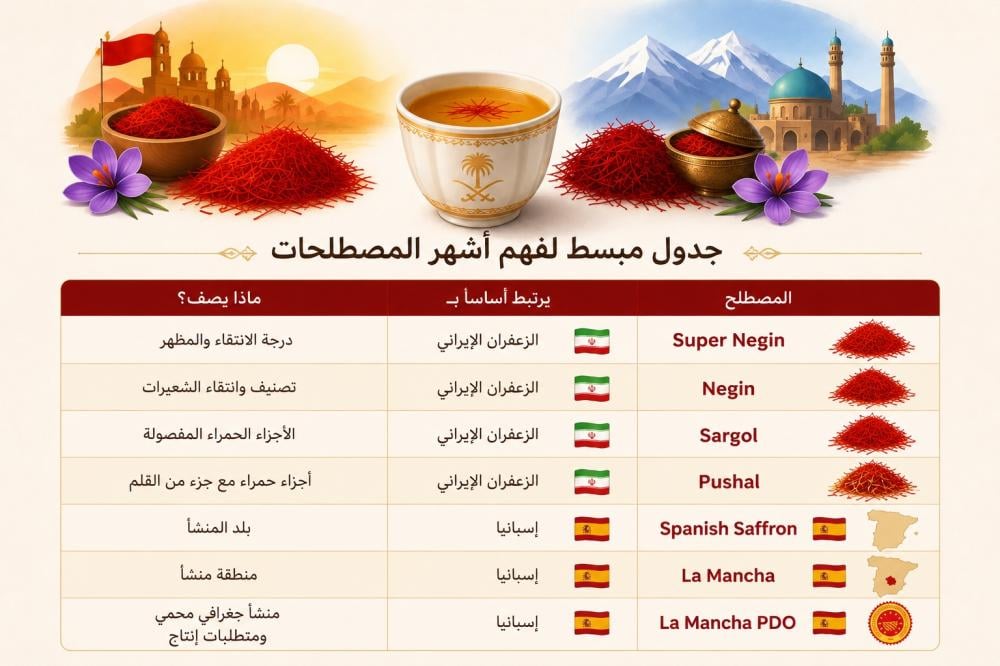
When searching for the best types of saffron in Saudi Arabia, you will encounter names and classifications such as Super Negin, Negin, Sargol, Pushal, and Spanish saffron from La Mancha. However, these terms do not all belong to the same classification system, so they cannot simply be ranked from “best” to “lowest quality.”
Choosing the best saffron depends more on the individual product, origin, classification, specifications, storage, and intended use than on a single name printed on the package.
This guide explains the main types and classifications of saffron available in the market, how they differ, and how to choose the right saffron for your needs.
Is There One Type That Can Be Considered the Best Saffron?
There is no single type of saffron that is best for every use.
One person may be looking for saffron for Saudi coffee, while another needs it for rice or desserts. Another buyer may place greater importance on protected origin and traceability than on the appearance of the saffron threads.
A more useful question is therefore:
Which saffron is best suited to my intended use?
rather than:
What is the best saffron in the world?
Country of origin, commercial name, or classification alone is not enough to determine the quality of every package.
What Are the Main Types of Saffron Available in Saudi Arabia?
The common options in the Saudi market can broadly be divided into two main groups:
Iranian saffron, with commercial classifications such as Super Negin, Negin, Sargol, and Pushal.
And Spanish saffron, including saffron produced in the La Mancha region and products protected under the La Mancha PDO designation.
It is important to understand that these names do not represent equivalent grades on a single quality scale.
What Is Super Negin Saffron?
Super Negin is one of the well-known commercial classifications associated with Iranian saffron.
It typically emphasizes carefully selected red stigma portions and a relatively uniform appearance, with greater separation from yellow parts of the flower.
The term relates largely to selection and commercial appearance. It does not, by itself, mean that every product labeled Super Negin is better than every other type of saffron.
The actual characteristics of a product can also be affected by the harvest, drying process, storage, packaging, and age.
What Is Negin Saffron?
Negin is another Iranian saffron classification associated with the appearance and selection of saffron stigma portions.
The precise distinction between Negin and Super Negin may vary between products, suppliers, and grading practices. For this reason, the name alone should not be the only factor used when comparing two packages from different sources.
Origin, packaging, traceability, and product specifications should also be considered.
What Is Sargol Saffron?
Sargol is a common Iranian saffron classification consisting primarily of separated red stigma portions.
A Sargol product can be high quality, but the word itself describes how parts of the flower have been selected rather than providing an independent guarantee of coloring strength, aroma, or flavor in every package.
It is therefore inaccurate to assume:
Sargol = one fixed level of quality in every case.
What Is Pushal Saffron?
With Pushal, portions of the red stigma generally remain attached to part of the style, giving it a different appearance from classifications based more exclusively on the red portions.
The presence of these parts does not automatically mean that the saffron is inauthentic or low quality. It represents a different way of preparing and presenting the flower.
This distinction matters because appearance alone is not enough to determine the authenticity or overall quality of saffron.
What Is Spanish Saffron?
Spanish saffron is saffron whose agricultural origin is Spain.
It is important to distinguish between:
Saffron of Spanish origin
and
Saffron packed in Spain.
A Spanish company name or a statement indicating that a product was packed in Spain does not necessarily mean that the saffron itself was grown and produced there.
When buying Spanish saffron, check the country of origin, not only the country of packaging.
For more detail, see Spanish Saffron: How Do You Really Identify Quality?.
What Is La Mancha PDO Saffron?
La Mancha is a Spanish region historically associated with saffron production.
Azafrán de La Mancha PDO is protected under a geographical origin system that connects the product to a defined region and production requirements associated with that protection.
An important distinction is:
PDO is not a grade such as Super Negin or Sargol.
Super Negin, Negin, Sargol, and Pushal are terms associated with the classification and preparation of Iranian saffron.
PDO, on the other hand, is a protected geographical origin designation with defined production requirements.
Therefore, a comparison such as:
“Is PDO higher than Super Negin?”
is not technically appropriate because the two terms describe different characteristics.
Is Iranian or Spanish Saffron Better?
There is no accurate answer based on nationality alone.
Iran and Spain have different traditions of saffron production and classification, and excellent products can come from either origin.
Differences between two packages may result from:
- Harvest conditions
- Drying method
- Classification and selection
- Storage
- Product age
- Packaging
- Preparation method
It is therefore more useful to compare specific products rather than turning country of origin into an absolute measure of quality.
For a detailed comparison, see Spanish vs Iranian Saffron: What Is the Difference?.
How Do You Choose the Best Saffron for Saudi Coffee?
In Saudi coffee, the goal is usually to achieve a balance between the aromas of coffee, cardamom, and saffron.
There is no rule that makes Super Negin, Spanish saffron, or any other origin the best choice in every case.
For a fair comparison, use the same amount of two different saffrons with:
the same amount of water, the same coffee and cardamom quantities, the same infusion method, and the same time of addition.
Then compare the actual result.
See Best Saffron for Saudi Coffee: Spanish or Iranian?.
For preparation instructions, read How to Use Saffron in Saudi Coffee.
What Is the Best Saffron for Rice and Cooking?
The choice again depends on the result you want.
If you are comparing coloring strength or aroma between two products, do not compare a large quantity of one with a smaller quantity of the other.
Use equal weights and the same infusion and preparation method.
Quantity and extraction method can substantially affect your impression of a saffron product.
See our guide to How Much Saffron to Use for Cooking and Coffee.
Does a Deep Red Color Mean Better Saffron?
Not necessarily.
Appearance is one observable characteristic, but it does not provide a complete measure of quality or purity on its own.
Similarly, releasing color quickly or producing an intense color in water does not by itself prove saffron authenticity.
A more reliable assessment combines product information, origin, traceability, sensory characteristics, and, where necessary, appropriate laboratory testing.
See How to Test Saffron Purity Before Buying.
Does a Higher Price Mean Better Saffron?
Not necessarily.
Saffron prices are influenced by several factors, including:
origin, harvest, classification, production costs, selection, packaging, certification, traceability, import costs, and package size.
Price can reflect some of these factors, but it is not an independent test of quality.
A product should not be considered the best simply because it is the most expensive, just as the cheapest product cannot automatically be considered the best value without understanding what is actually being compared.
How Should You Choose Saffron Before Buying?
Instead of relying on the phrase “best saffron,” evaluate several indicators together.
1. Country of Origin
Look for where the saffron was grown and produced, not merely where it was packed.
2. Classification
If an Iranian product is classified as Negin, Super Negin, or Sargol, understand what the classification describes rather than treating it as a standalone guarantee of quality.
3. Traceability
The clearer the information about the product, origin, and supplier, the easier it is to make a verifiable purchasing decision.
4. Packaging Condition
The packaging should protect saffron from moisture, light, and unnecessary exposure to air.
5. Storage
Even good saffron can lose some of its characteristics when exposed to light, heat, or moisture for extended periods.
6. Compare by Weight
When comparing prices, calculate the price relative to the actual weight rather than comparing the total prices of packages of different sizes.
For more guidance, see A Guide to Buying Authentic Saffron Before You Pay.
What Are the Best Types of Saffron in Saudi Arabia?
If “best” means the highest possible quality, there is no reliable answer based on classification name alone.
The Saudi market offers Iranian saffron in several classifications and Spanish saffron from different production areas, including La Mancha PDO saffron.
A better choice is a product that combines:
clear origin + reliable information + understandable classification + appropriate packaging and storage + characteristics suited to the intended use.
Statements such as “Super Negin is the best saffron in the world” or “Spanish saffron is always better than Iranian saffron” oversimplify a comparison that depends on the individual products involved.
Conclusion
There is no universal ranking that places Super Negin, Negin, Sargol, and La Mancha PDO from first to last because these terms do not describe the same thing.
When choosing the best saffron in Saudi Arabia, start by considering true origin, classification, traceability, storage, and your intended use.
If you are interested in Spanish saffron, verify that Spain is the country of origin rather than relying only on a “packed in Spain” statement.
If you are choosing Iranian saffron, use classifications such as Super Negin, Negin, and Sargol to understand how the product has been selected and presented, rather than treating the classification as a standalone guarantee of quality.
This approach makes it possible to compare saffron based on what the product actually represents, rather than simply choosing the most familiar name on the package.