
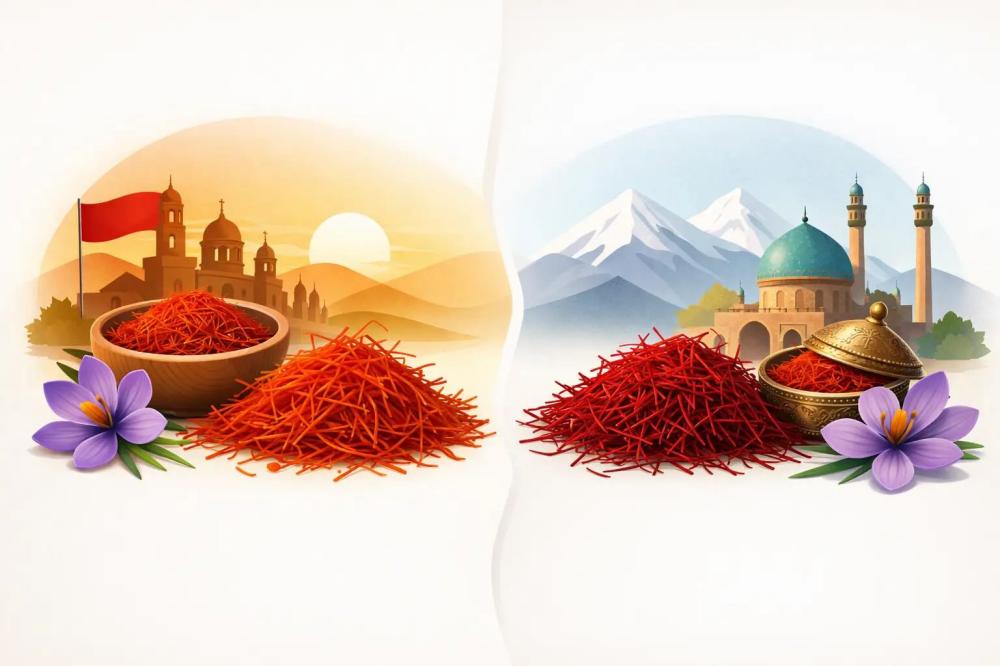
Is Spanish saffron better than Iranian saffron? There is no single answer that applies to every product or use.
Spain and Iran represent different saffron origins, with different classification systems, production traditions, and commercial characteristics. A useful comparison therefore does not begin with “Which country is better?” but with: Which products are being compared, and what do you want from your saffron?
What Is the Main Difference Between Spanish and Iranian Saffron?
The first difference is country of origin.
Spanish Saffron originates in Spain, while Iranian Saffron originates in Iran.
Country of origin alone, however, does not determine the quality of every package.
Products within the same country can differ according to harvest, drying, sorting, purity, storage, packaging, and specifications.
It is therefore inaccurate to treat all Spanish saffron as one identical product or all Iranian saffron as one quality grade.
What Makes Spanish La Mancha PDO Saffron Different?
La Mancha PDO Saffron is more specific than simply describing saffron as Spanish.
PDO is a Protected Designation of Origin linked to a defined geographical area in Castilla-La Mancha and to requirements covering production, packaging, control, and traceability.
Spanish La Mancha PDO Saffron therefore provides buyers with an additional element: geographical origin documented within an official system.
PDO status does not mean that every comparison with every Iranian saffron automatically favors the Spanish product. It documents origin and defines product requirements within an official system rather than declaring every other saffron inferior.
For more detail on verifying this origin, read: How to Identify Authentic Spanish Saffron and Its Quality.
What Makes Iranian Saffron Different?
Iran is one of the world's major saffron-producing origins, and Iranian saffron is sold under several commercial classifications.
Common terms include:
Super Negin
Negin
Sargol
Pushal
These classifications primarily describe thread selection, appearance, and the portions retained in the product.
Iranian products can vary significantly in selection, specifications, and quality. The words “Iranian saffron” alone therefore do not provide a complete quality assessment.
For more detail, read: How to Identify Authentic Iranian Saffron and Its Quality.
Is Iranian Saffron Stronger in Color?
This cannot be generalized across all Iranian and Spanish saffron.
Coloring strength is a measurable characteristic associated particularly with compounds including crocin.
The result depends on the individual sample, not simply the nationality stated on the package.
A particular Iranian saffron may have stronger coloring characteristics than a particular Spanish saffron, while another comparison may produce the opposite result.
If coloring strength matters, compare the actual specifications of the products.
Which Has a Stronger Aroma?
The same principle applies to aroma.
Saffron aroma is associated in part with safranal and can be influenced by drying conditions, product age, packaging, and storage.
There is therefore no simple scientific rule stating that all Spanish saffron is more aromatic than Iranian saffron or vice versa.
Accurate comparison requires specific samples or products.
Does Spanish Saffron Taste Different From Iranian Saffron?
Sensory differences can exist between products, but taste is not determined by country of origin alone.
Picrocrocin is associated with saffron's characteristic taste, while drying, storage, concentration, and preparation can also influence the final experience.
A consumer may notice differences between a particular Spanish and Iranian saffron, but the experience of two samples should not be generalized to the entire production of both countries.
Which Is Better for Saudi Coffee?
Both origins can be used in Saudi coffee.
The choice depends on the result you prefer, the amount used, preparation method, and the characteristics of the individual saffron product.
There is no rule requiring Saudi coffee to use saffron from only one origin.
For a practical comparison, use the same quantity and preparation method with both products and compare their color, aroma, and taste.
For more detail, read: Best Saffron for Saudi Coffee and How to Use It.
Which Is Better for Rice and Desserts?
Both Spanish and Iranian saffron can be used in rice, desserts, and beverages.
In culinary applications, the performance of the individual product and how it is prepared can matter more than the country name alone.
Quantity, infusion method, temperature, and the stage at which saffron is added can all influence the result.
Choosing saffron for a recipe should therefore not depend solely on whether it is Spanish or Iranian.
For preparation guidance, read: How to Use Saffron in Cooking and Drinks.
Is Spanish Saffron More Expensive Than Iranian Saffron?
Not always.
Prices vary according to the individual product, classification, quality, packaging, weight, and supply chain.
La Mancha PDO also operates under an origin and documentation system different from the commercial classifications used for Iranian saffron.
Compare the price per gram of specific products, then consider origin, specifications, and documentation.
For more detail, read: Spanish vs Iranian Saffron Price: How Should You Compare?
Which Origin Is Easier to Verify?
When a product carries La Mancha PDO, an official system connects it to geographical origin and traceability, providing a clear layer of documentation.
For Iranian saffron, buyers should verify the country of origin, product information, supplier, packaging, and available traceability information.
This represents a difference in origin documentation systems, not an automatic judgment about the sensory quality of each product.
Is Negin Better Than La Mancha PDO?
This is not a like-for-like comparison.
Negin is a commercial term used to describe the selection and appearance of Iranian saffron threads.
La Mancha PDO is a Protected Designation of Origin connected to a geographical area and a system covering production, packaging, and traceability.
The two terms therefore describe different things.
A specific Iranian Negin product can be compared with a specific La Mancha PDO product in terms of characteristics, price, and use, but Negin and La Mancha PDO cannot be ranked as two grades on a single quality scale.
How Should You Choose Between Spanish and Iranian Saffron?
Start with what matters in your purchasing decision.
If documented Spanish geographical origin and PDO status matter to you, consider Spanish La Mancha PDO Saffron.
If you are choosing Iranian Saffron, check its origin, classification, product information, and available specifications rather than relying on the grade name alone.
In either case, do not use color, price, or thread appearance as the sole basis for judging quality.
For a complete purchasing checklist, read: Authentic Saffron Buying Guide: What to Check Before You Buy.
Spanish and Iranian Saffron From Antonio Sotos
Antonio Sotos has specialized in saffron since 1912.
In Saudi Arabia, Antonio Sotos offers two clearly distinguished origins:
Spanish La Mancha PDO Saffron — originating in Spain.
Iranian Saffron — originating in Iran and selected and packaged by Antonio Sotos in Spain.
This allows buyers to experience and compare both origins while clearly understanding where each product comes from.
Conclusion: Spanish or Iranian Saffron?
There is no universal winner.
Spanish and Iranian saffron represent different origins, and a country name alone cannot determine which individual product is better.
If documented geographical origin is your priority, La Mancha PDO provides a clear system for that purpose. When choosing Iranian saffron, understand the commercial classification and actual product specifications.
For color, aroma, taste, and quality, the more accurate approach is to evaluate the specific product, rather than making a general judgment about an entire country.