
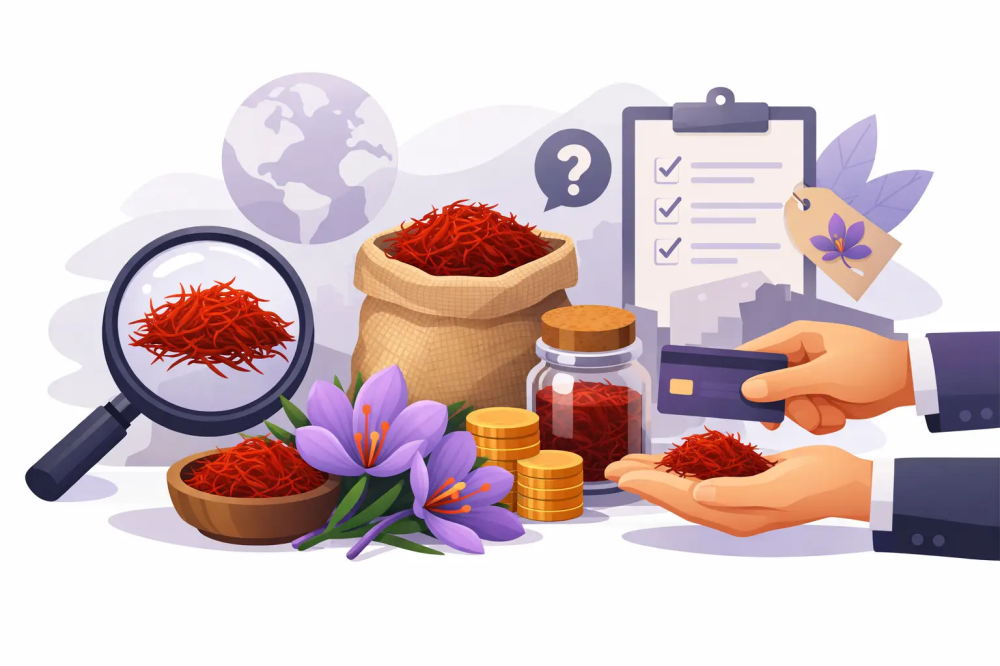
Buying authentic saffron is not simply about choosing the reddest threads, the highest price, or a particular country of origin. A better decision starts with understanding saffron origin, product information, quality assessment, packaging, and traceability.
Whether you are buying Spanish Saffron or Iranian Saffron, there are several factors worth checking before purchase rather than relying solely on visual appearance or home tests.
1. Check the Country of Origin
The first thing to check is the country of origin.
There is an important difference between where saffron was grown and produced and where it was later packaged. Iranian saffron, for example, may be packaged in Spain.
Therefore, “Packed in Spain” does not necessarily mean “Spanish origin.” Always check the declared country of origin separately.
2. Do Not Judge Saffron by Color Alone
Red threads can provide a visual clue, but color alone does not prove authenticity or quality.
Saffron assessment involves several characteristics, including purity, moisture, coloring strength, aroma, and taste.
Three important compounds associated with saffron's characteristics are:
- Crocin: associated with coloring strength.
- Safranal: associated with aroma.
- Picrocrocin: associated with taste.
There is therefore no reliable rule that “the reddest saffron is always the best.”
3. Understand the ISO 3632 Saffron Standard
ISO 3632 is an important international reference for specifications and testing methods for dried saffron.
It covers saffron sold as whole threads, cut threads, and powder and provides a more objective framework for assessing saffron than appearance alone.
When reliable analytical data is available, it can provide more useful information about saffron characteristics than home testing.
4. Understand Origin vs. Grade
Not every term on a saffron package means the same thing.
Terms such as Spanish and Iranian describe origin when used correctly, while terms including Negin, Sargol, and Pushal are commonly used in the Iranian saffron trade to describe thread selection and appearance.
La Mancha PDO, on the other hand, is a Protected Designation of Origin linked to a defined geographical area and an official system covering production, packaging, and traceability.
Understanding what each term actually represents is more useful than treating them all as equivalent “quality grades.”
5. How Can You Identify Authentic Spanish Saffron?
If you are buying Spanish saffron, first verify that its country of origin is Spain.
When buying Spanish La Mancha PDO Saffron, there is an additional layer of documentation. The Protected Designation of Origin is linked to a defined production area and official requirements covering the product, packaging, and traceability.
For a detailed explanation, read: How to Identify Authentic Spanish Saffron and Its Quality
6. How Can You Identify Authentic Iranian Saffron?
When buying Iranian Saffron, verify that the declared country of origin is Iran, then review the available product, packaging, purity, and specification information.
Terms such as Negin, Super Negin, Sargol, and Pushal are commonly used in the Iranian saffron trade. They help describe thread selection and appearance but do not independently provide a complete scientific assessment of quality.
For more detail, read: How to Identify Authentic Iranian Saffron and Its Quality
7. Are Home Saffron Tests Reliable?
Many home tests for saffron involve placing the threads in water and observing how the color develops.
These tests may provide initial observations, but they cannot conclusively establish saffron authenticity or quality on their own.
Saffron is a natural product, and its characteristics can be affected by factors including drying, storage, moisture, and product composition.
Water tests, aroma tests, or rubbing the threads should therefore not be treated as definitive proof that saffron is authentic or adulterated.
For a detailed explanation, read: How to Test Saffron Purity: Are Home Tests Reliable?
For warning signs worth checking before purchase, read: 7 Signs That May Indicate Adulterated Saffron
8. Check the Packaging and Product Information
Before buying saffron, review the information provided on the package or product page, including:
- Country of origin.
- Product name.
- Net weight.
- Company responsible for packaging.
- Batch or traceability information, when available.
- Expiry date and storage instructions.
- Certifications or specifications, while understanding what each certification actually verifies.
The clearer and more verifiable the product information is, the better informed your purchase decision can be.
9. Does Cheap Saffron Mean It Is Fake?
Price alone cannot prove that saffron is adulterated.
Saffron prices vary according to factors such as origin, grade, harvest, quality, packaging, package size, and supply chain.
An unusually low price may justify closer inspection, but it is not independent proof of adulteration. Likewise, a high price does not guarantee quality.
For a more accurate comparison, read: Spanish vs Iranian Saffron Price: How Should You Compare?
10. Which Is Better: Spanish or Iranian Saffron?
There is no universal answer that applies to every product.
Spanish saffron and Iranian saffron differ in origin, classification systems, documentation, and product characteristics.
It is more useful to compare specific saffron products according to their origin, specifications, quality, and traceability than to assume that one entire country always produces better saffron than another.
For a detailed comparison, read: Spanish vs Iranian Saffron: What Is the Difference and Which Is Better?
If you primarily use saffron in coffee, read: Best Saffron for Saudi Coffee: Spanish or Iranian?
Buying Antonio Sotos Saffron in Saudi Arabia
Antonio Sotos has specialized in saffron since 1912.
In Saudi Arabia, Antonio Sotos offers two clearly identified origins: Spanish La Mancha PDO Saffron originating in Spain and Iranian Saffron originating in Iran and selected and packaged by Antonio Sotos in Spain.
This allows buyers to choose between the two origins while clearly identifying where each saffron product comes from.
Quick Checklist Before Buying Saffron
Before completing your purchase, ask:
- What is the country of origin?
- Is the product and packaging information clear?
- What does the stated grade or classification actually mean?
- Is quality or traceability information available?
- Am I relying on verifiable information or only on color and price?
Answering these questions provides a more reliable basis for choosing saffron than judging thread appearance alone.
Conclusion
The best way to buy authentic saffron is to verify rather than guess.
Start with the country of origin, then examine the product information, packaging, classification, specifications, and traceability when available. Do not treat color, price, or a single home test as definitive proof of authenticity or quality.
Good saffron should come with clear, verifiable information about what it is and where it comes from.