
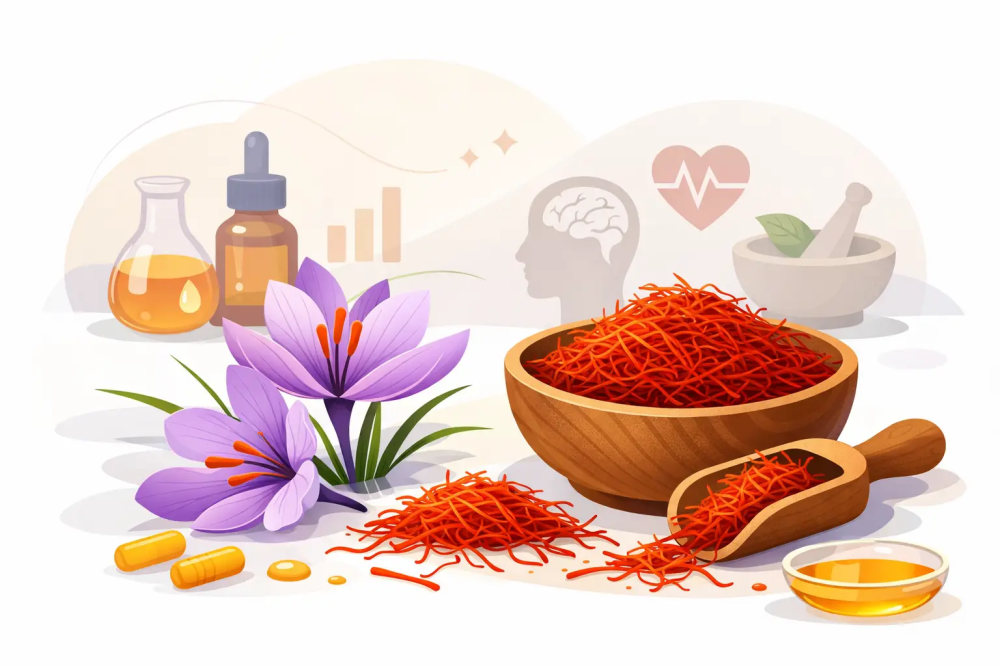
Saffron has been associated with food and traditional uses for centuries. As scientific research has developed, saffron and its compounds have become the subject of an increasing number of studies investigating their potential effects.
Searching for saffron benefits, however, often produces long lists of claims that go beyond what research has actually established.
It is therefore important to distinguish between three things: using saffron as a food and spice, studying its compounds in laboratory research, and using specific saffron extracts at measured doses in clinical trials.
What Compounds Are Found in Saffron?
Saffron consists of dried stigmas from the flower Crocus sativus L. and contains several compounds that contribute to its distinctive characteristics.
Among the best known are:
Crocin — primarily associated with saffron's color.
Picrocrocin — associated with its characteristic taste.
Safranal — an important compound associated with saffron's aroma.
These compounds are also central to much of the scientific research involving saffron.
However, the presence of biologically active compounds does not automatically mean that consuming a small culinary quantity of saffron treats disease or produces a specific therapeutic effect.
Does Saffron Have Scientifically Proven Benefits?
A more accurate description is that there are several areas of research supported by different levels of evidence.
Clinical trials and systematic reviews have investigated saffron and saffron extracts in areas including mood, sleep, and several other health outcomes.
Some findings are promising.
However, studies differ in:
The saffron product or extract used.
Dose.
Duration.
Study population.
How outcomes are measured.
Research findings therefore cannot automatically be converted into general health promises applying to every saffron product and every culinary quantity.
What Does Research Say About Saffron and Mood?
Mood is one of the more extensively investigated areas of clinical saffron research.
Reviews of randomized clinical trials have reported findings suggesting that saffron or certain saffron extracts may influence some measures of mood and symptoms of depression and anxiety in studied populations.
These findings need to be interpreted in context.
Clinical studies generally use specific products and measured doses under research conditions. They do not demonstrate that adding a few saffron threads to rice or coffee constitutes treatment for depression or anxiety.
Saffron should therefore not be used as a substitute for medical diagnosis or treatment.
Can Saffron Help With Sleep?
Sleep is another area in which human studies have been conducted.
Some randomized trials and systematic reviews have reported improvements in certain sleep-quality measures among participants taking specific saffron preparations or extracts compared with placebo.
These findings are scientifically interesting, but they do not establish that every culinary use of saffron will improve sleep.
Extract type, dose, duration, and participant characteristics are important when interpreting the results.
It is therefore more accurate to say that saffron has been studied for sleep and some clinical findings are promising, rather than describing it as a proven treatment for insomnia.
Is Saffron an Antioxidant?
Saffron and its constituents contain compounds that have demonstrated antioxidant properties in scientific research.
However, the word “antioxidant” is often used in marketing far more broadly than the evidence allows.
Demonstrating antioxidant activity in a laboratory does not automatically mean that consuming saffron prevents a particular disease in humans.
This characteristic is better understood as part of saffron's chemistry and scientific research, rather than a promise of disease prevention or treatment.
Is Saffron Good for Memory and Concentration?
Saffron compounds and extracts have been investigated in research related to cognition and neurological function.
There are findings worthy of further study, but the evidence varies according to the condition, population, and research design.
It cannot therefore be concluded that adding saffron to food will necessarily improve memory or concentration in a healthy person.
Again, clinical research involving specific extracts should be distinguished from ordinary culinary use.
Is Saffron Good for the Heart?
Studies have investigated saffron or its extracts in relation to several cardiovascular and metabolic markers.
However, the statement “saffron is good for the heart” is too broad without further qualification.
Saffron should not be considered a treatment for high cholesterol, hypertension, or cardiovascular disease, and it should not replace medical treatment or dietary recommendations from qualified professionals.
Saffron can be enjoyed as part of food, but therapeutic claims require a much higher level of evidence.
Does Saffron Boost the Immune System?
This is a common online claim that requires caution.
The presence of plant compounds with biological activity is not sufficient to establish that consuming saffron “boosts immunity” in a clinically demonstrated way.
The immune system is complex, and broad claims about strengthening it often do not accurately represent what research has measured.
We therefore avoid using this as a general claim about saffron benefits.
Can Saffron Help With Weight Loss?
Some saffron preparations have been investigated in contexts related to appetite, snacking behavior, and weight.
This does not make saffron a weight-loss product.
There is insufficient justification for treating culinary saffron threads as a direct method for losing weight.
Weight management involves multiple dietary, behavioral, and health factors and should not be reduced to a single food ingredient.
Does Saffron Have Specific Benefits for Men or Women?
Studies have investigated saffron in different health contexts involving both men and women, including certain psychological, sexual, and condition-specific outcomes.
Turning these studies into broad statements such as “saffron benefits for men” or “saffron benefits for women” can be misleading without specifying the condition, dose, and product studied.
Saffron benefits should not simply be divided according to sex.
A more accurate approach is to examine each health outcome and its supporting evidence independently.
Does Saffron in Saudi Coffee Provide the Same Benefits Studied in Clinical Trials?
This cannot be assumed.
Many clinical studies investigating specific health effects use measured doses or standardized saffron extracts.
The amount of saffron used in Saudi coffee, rice, and desserts is primarily used for aroma, taste, and color.
A result from a clinical study using a specific supplement or extract therefore cannot automatically be attributed to a cup of coffee containing a few saffron threads.
This distinction is essential when evaluating health claims about saffron.
Is Spanish Saffron Healthier Than Iranian Saffron?
There is no scientific basis for stating that Spanish La Mancha PDO Saffron provides greater health benefits than Iranian Saffron, or vice versa, based solely on country of origin.
Individual products can differ in composition and specifications, but health research does not justify generally ranking these origins according to “health benefits.”
When choosing saffron for food, focus on authenticity, origin, quality, storage, and appropriate use rather than treating one origin as a better medicine.
Is Natural Saffron the Same as Saffron Supplements?
They are not equivalent in how they are used.
Saffron threads are a food product used in cooking and beverages.
Supplements and extracts may be standardized to particular concentrations and doses and designed for different purposes.
The doses used in clinical studies therefore cannot simply be replaced by an arbitrary quantity of saffron threads, and results involving one standardized extract should not automatically be used to market every saffron product.
Is Saffron Safe to Consume?
Using saffron in normal culinary quantities is different from consuming high doses or concentrated extracts.
The word “natural” does not mean that every amount is appropriate for every person.
If saffron is being considered in high doses or supplement form, during pregnancy, alongside a medical condition, or with regular medications, advice from a qualified healthcare professional is appropriate rather than relying on general food information.
For cooking, saffron should be treated as a spice and used in quantities appropriate to the recipe.
Does Authentic Saffron Mean Greater Health Benefits?
Authenticity and quality matter, but they should not be confused with proof of a therapeutic effect.
Buying saffron with identifiable origin and product information helps establish what you are actually using.
Even authentic, high-quality saffron should not be described as treating disease without adequate evidence for the specific claim.
For guidance on assessing a product before purchase, read: How to Identify Authentic Saffron Before Buying.
Saffron From Antonio Sotos
Antonio Sotos has specialized in saffron since 1912.
In Saudi Arabia, Antonio Sotos offers Spanish La Mancha PDO Saffron and Iranian Saffron in thread form for culinary use and beverages.
We approach saffron first as a food ingredient with an identifiable origin and measurable characteristics, rather than relying on therapeutic promises to establish its value.
Conclusion: What Are the Real Benefits of Saffron?
Saffron contains important compounds including crocin, picrocrocin, and safranal, and there is a growing body of human research investigating potential effects of saffron preparations, particularly in areas such as mood and sleep.
The strength of evidence, however, is not the same for every benefit commonly claimed online.
Most importantly, results from studies using specific extracts and measured doses cannot automatically be transferred to the small quantities used in cooking or coffee.
The most accurate description is therefore not that saffron “treats” a long list of conditions, but that it is a spice with distinctive chemistry, while some of its compounds and extracts have produced promising research findings that should be interpreted carefully and without exaggeration.