
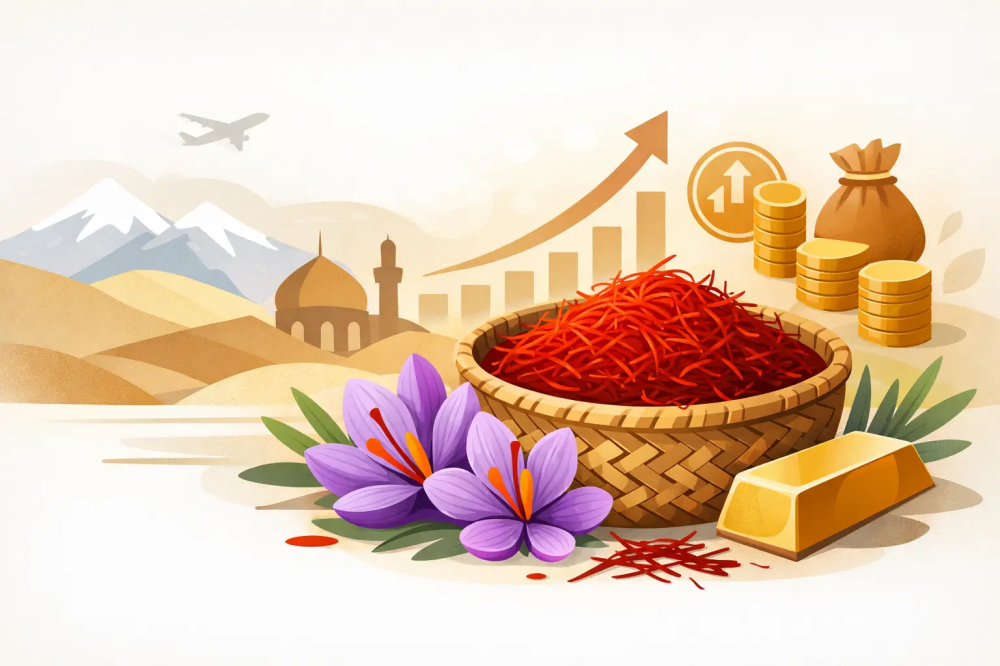
Saffron is a high-value spice, and Iranian saffron is no exception. However, its price is not determined simply by Iranian origin or package size.
The final price can reflect several factors, beginning with cultivation and manual harvesting and continuing through drying, sorting, quality assessment, packaging, and the supply chain.
When comparing Iranian saffron prices, it is therefore more useful to understand what you are actually buying than to compare package prices alone.
Why Is Saffron Expensive in the First Place?
Saffron comes from the Crocus sativus L. flower. Each flower produces only a limited number of stigmas that must be collected, separated, and dried.
Much of this process depends on manual work, particularly during harvesting and the separation of the relevant flower parts.
Producing even a relatively small quantity of dried saffron therefore requires handling a large number of flowers.
Saffron's value is consequently linked to the nature of its production and the labor required, rather than simply to a marketing perception of rarity.
Is All Iranian Saffron Priced the Same?
No.
Iranian Saffron is not a single standardized product that is identical in every package.
Products can differ according to:
- Harvest and season.
- Production area.
- Drying method.
- Thread sorting.
- Portions of the thread retained.
- Purity and moisture.
- Characteristics associated with color, aroma, and taste.
- Packaging and pack size.
- Testing and quality control.
- Supply chain.
Comparing the price of one gram of Iranian saffron with another gram without understanding the specifications of both products can therefore be misleading.
Do Negin, Super Negin, and Sargol Affect Price?
Terms such as Negin, Super Negin, Sargol, and Pushal are commonly used in the Iranian saffron trade to describe thread selection, appearance, and the portions retained in the product.
Certain forms of sorting may require greater selection or produce threads with a more uniform visual presentation, which can influence commercial value.
However, it is important to distinguish between a commercial grade and a complete scientific assessment of quality.
The term Super Negin, for example, does not independently prove that a product has the highest coloring strength, strongest aroma, or best chemical characteristics.
For a detailed explanation of these grades, read: How to Identify Authentic Iranian Saffron and Its Quality.
Does Redder Iranian Saffron Cost More?
Thread appearance and the proportion of red portions can influence commercial classification and price, but redness alone is not a complete measure of quality.
Important compounds associated with saffron characteristics include:
- Crocin: associated with coloring strength.
- Picrocrocin: associated with taste.
- Safranal: associated with aroma.
Moisture, purity, drying, and storage can also affect the final product.
Two saffron samples can therefore appear visually similar while differing in other characteristics.
How Does Manual Harvesting Affect Saffron Price?
Saffron flowers are harvested during a limited flowering period, and the relevant parts must then be carefully separated before drying.
Because the part ultimately used as saffron represents only a small portion of each flower, producing commercial quantities requires handling many flowers.
The labor and time involved in harvesting, separating, and drying saffron therefore contribute significantly to production costs.
Does Packaging Increase the Price of Saffron?
Yes, but packaging is only one factor.
Small retail packages are generally not priced in the same way as bulk quantities when calculated on a per-gram basis.
The final retail price can include:
- Packaging.
- Packing and quality control.
- Transportation and storage.
- Importation and distribution.
- Applicable taxes and duties.
- Local retail and delivery costs.
The price paid by a consumer therefore does not represent the raw saffron price alone.
Why Do Iranian Saffron Prices Vary in Saudi Arabia?
Once saffron reaches the Saudi market, its retail price is not determined solely by the price of saffron in Iran.
There is a difference between the source price of raw saffron and the price of a packaged product ready for retail sale in Saudi Arabia.
Selection, packaging, testing, shipping, importation, storage, distribution, and retail can all contribute to the final cost.
Products can also differ in weight, grade, quality, and presentation, so packages labeled “Iranian saffron” should not automatically be compared on price alone.
Does Cheap Iranian Saffron Mean It Is Fake?
Not necessarily.
A low price does not prove adulteration, just as a high price does not prove quality.
However, if a product is substantially cheaper than apparently comparable products, it is reasonable to check:
actual weight, country of origin, classification, product labeling, supplier, and available specifications.
For warning signs worth investigating, read: 7 Signs That May Indicate Adulterated Saffron.
How Should You Compare Saffron Prices?
Start by calculating the price per gram rather than comparing package prices.
Then go beyond the number and compare:
- Country of origin.
- Net weight.
- Product type or classification.
- Available quality information.
- Packaging.
- Supplier identity.
- Traceability or analytical information when available.
A 1-gram package and an 8-gram package, for example, may have very different prices per gram even when they contain the same saffron.
Is Iranian Saffron More Expensive Than Spanish Saffron?
There is no fixed rule.
The price of Iranian Saffron and Spanish Saffron varies according to the specific product, harvest, classification, quality, packaging, and supply chain.
Spanish La Mancha PDO Saffron also operates under a Protected Designation of Origin system with requirements related to origin, production, packaging, and traceability, while the Iranian saffron trade uses a different commercial classification system.
It is therefore more meaningful to compare specific products rather than assume that one origin is always more expensive than the other.
Antonio Sotos Iranian Saffron
Antonio Sotos has specialized in saffron since 1912.
In Saudi Arabia, Antonio Sotos offers Iranian Saffron originating in Iran and selected and packaged by Antonio Sotos in Spain.
Spanish La Mancha PDO Saffron is offered as a separate origin, allowing buyers to clearly identify the country of origin of each product.
Conclusion: What Determines Iranian Saffron Price?
Iranian saffron price does not simply reflect its country of origin.
It results from a combination of factors including manual harvesting, drying, sorting, classification, product characteristics, packaging, pack size, and the supply chain.
When you find a significant price difference between two saffron products, the most useful question is therefore not simply “Which one is cheaper?”
It is: What is different about the two products I am comparing?