
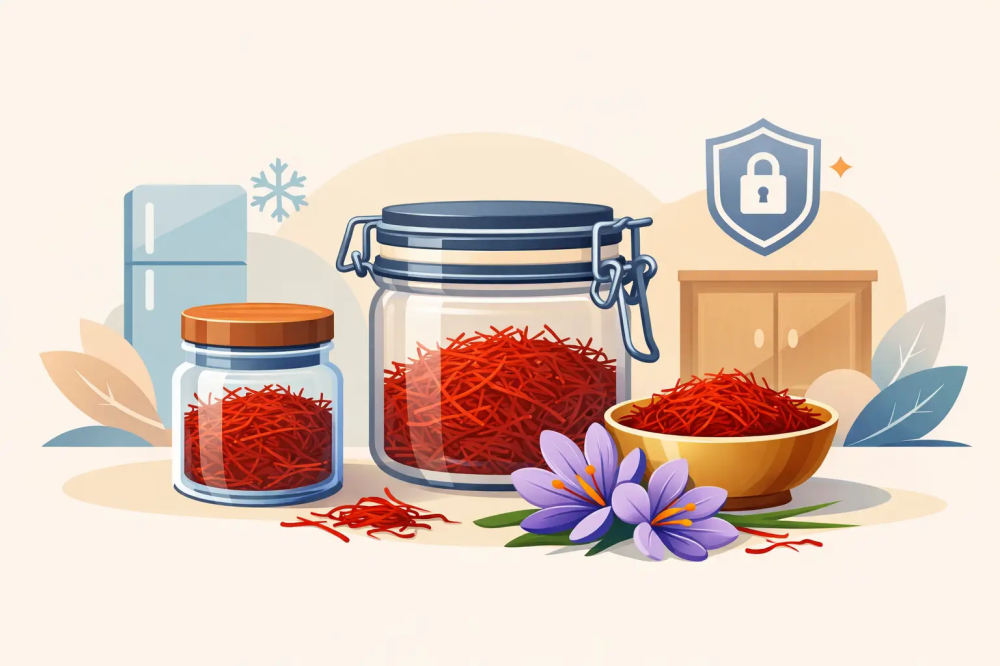
How saffron is stored can affect how well it retains its characteristics over time. Although dried saffron may appear stable, continued exposure to light, heat, moisture, and air can gradually affect its color, aroma, and taste.
If you buy high-quality saffron, proper storage after opening the package is therefore an important part of maintaining the product.
What Is the Best Way to Store Saffron?
The basic rule is simple:
Store saffron in a tightly sealed container in a dry, dark place at a moderate and stable temperature, away from heat, moisture, and strong odors.
A closed kitchen cupboard away from the oven, stove, and direct sunlight is suitable in most homes.
Do not leave the saffron package open after use. Close it promptly and return it to its storage location.
Why Should Saffron Be Protected From Light?
Saffron's color is associated with compounds including crocin, and these compounds can be affected by storage conditions.
Saffron should therefore not be left in a transparent container continuously exposed to sunlight or strong light.
A transparent container can still be used if it is kept inside a dark cupboard when not in use.
The objective is to reduce prolonged exposure to light, rather than focusing only on the color of the container.
Why Does Heat Matter?
Temperature is an important factor in the stability of compounds responsible for saffron's characteristics.
Avoid storing saffron:
- Beside an oven.
- Above a stove.
- Near a sunny window.
- Inside a car or another location that becomes very hot.
In hot climates such as Saudi Arabia, this is particularly relevant. Choose an indoor location with relatively stable temperatures rather than an area exposed to large temperature changes.
Does Moisture Affect Saffron?
Yes. Saffron is a dried product and should be protected from moisture.
Avoid placing wet fingers or utensils inside the package, and do not leave it open near steam while cooking or preparing coffee.
Keeping the container tightly closed also helps reduce exposure to moisture in the surrounding air.
Should Saffron Be Stored in the Refrigerator?
Refrigeration is generally unnecessary for everyday household saffron storage.
Saffron can be stored appropriately in a dry, dark place at a moderate indoor temperature.
The potential issue with refrigeration is not the cold itself but moisture and condensation when a cold container is removed and opened in warmer air.
If you have a relatively cool, stable, and dry indoor location, a closed cupboard is generally simpler for everyday use.
Can You Store Saffron in the Freezer?
For small packages that are used regularly, there is usually no practical need to freeze saffron.
Repeatedly removing and returning a package can increase the possibility of condensation and moisture exposure if it is not handled carefully.
For normal household storage, protecting saffron from light, heat, moisture, and prolonged exposure to air is more important.
What Is the Best Container for Saffron?
Use a container that is:
tightly sealed, clean, dry, and free from strong residual odors.
Saffron can remain in its original packaging if that package is designed for storage and can be properly resealed.
If you transfer it to another container, choose an appropriate size and make sure the container is completely clean and dry.
There is no need to transfer saffron simply because another container looks better. If the original packaging is intact and closes securely, keeping it there is often the simplest option.
Can Saffron Be Stored in Plastic?
The performance of the packaging is more important than the material alone.
If the original food-safe saffron packaging seals properly and protects the product, there is no inherent need to transfer the saffron.
The more important concerns are containers that do not seal effectively or retain strong odors from previously stored products.
Can Saffron Absorb Other Odors?
It is sensible to keep saffron away from strongly aromatic materials.
Do not store it in a container previously used for strongly scented food or spices unless the container has been thoroughly cleaned and is completely odor-free.
Close the package after each use rather than leaving it open beside coffee or spices.
Is It Better to Store Saffron as Threads or Powder?
If you purchase saffron as threads, it is generally practical to keep it in thread form and crush or grind only the amount required for each use.
Threads also allow easier visual inspection of the product than powder.
If your saffron is already powdered, pay particular attention to keeping the package sealed and limiting its exposure to air, moisture, and light.
How Long Does Saffron Last?
The first reference should always be the expiry date and storage instructions provided on the package.
However, shelf life should be distinguished from retaining maximum sensory characteristics.
Over time, saffron's coloring strength, aroma, and taste may gradually decline, particularly when storage conditions are poor.
There is therefore no single precise period during which every saffron product will retain identical quality regardless of packaging and storage conditions.
How Can You Tell if Saffron Has Lost Quality?
Over time, you may notice:
- A weaker aroma.
- Less coloring effect during use.
- A less pronounced taste.
These observations do not establish authenticity or adulteration. They simply help assess changes that may have occurred during storage.
For authenticity and purity testing, read How to Test Saffron Purity: Are Home Tests Reliable?
Is Spanish Saffron Stored Differently From Iranian Saffron?
The fundamental principles are the same.
Whether you use Spanish La Mancha PDO Saffron or Iranian Saffron, it should be protected from heat, moisture, light, and prolonged exposure to air.
Origin does not remove the need for proper storage.
How Should You Store Saffron Used for Saudi Coffee?
If you regularly use saffron in Saudi coffee, avoid keeping the package next to the dallah or stove simply for convenience.
Heat and steam around the coffee preparation area do not provide suitable storage conditions.
Take the amount you need, close the package immediately, and return it to a dry, dark cupboard.
Storing Antonio Sotos Saffron
Antonio Sotos has specialized in saffron since 1912 and offers Spanish La Mancha PDO Saffron and Iranian Saffron in Saudi Arabia in several pack sizes.
After opening the package, keep it properly closed and store it away from light, heat, and moisture to help preserve the saffron's characteristics until its next use.
Conclusion: Where Should You Store Saffron?
For normal household storage:
Tightly sealed container + dark location + dry environment + moderate temperature.
Do not leave saffron beside the stove or in direct sunlight, protect it from moisture and steam, and close the package promptly after use.
Under normal household conditions, complicated storage methods are unnecessary. Stable storage conditions and protection from the factors that affect saffron quality are what matter most.